📊 Quick Verdict
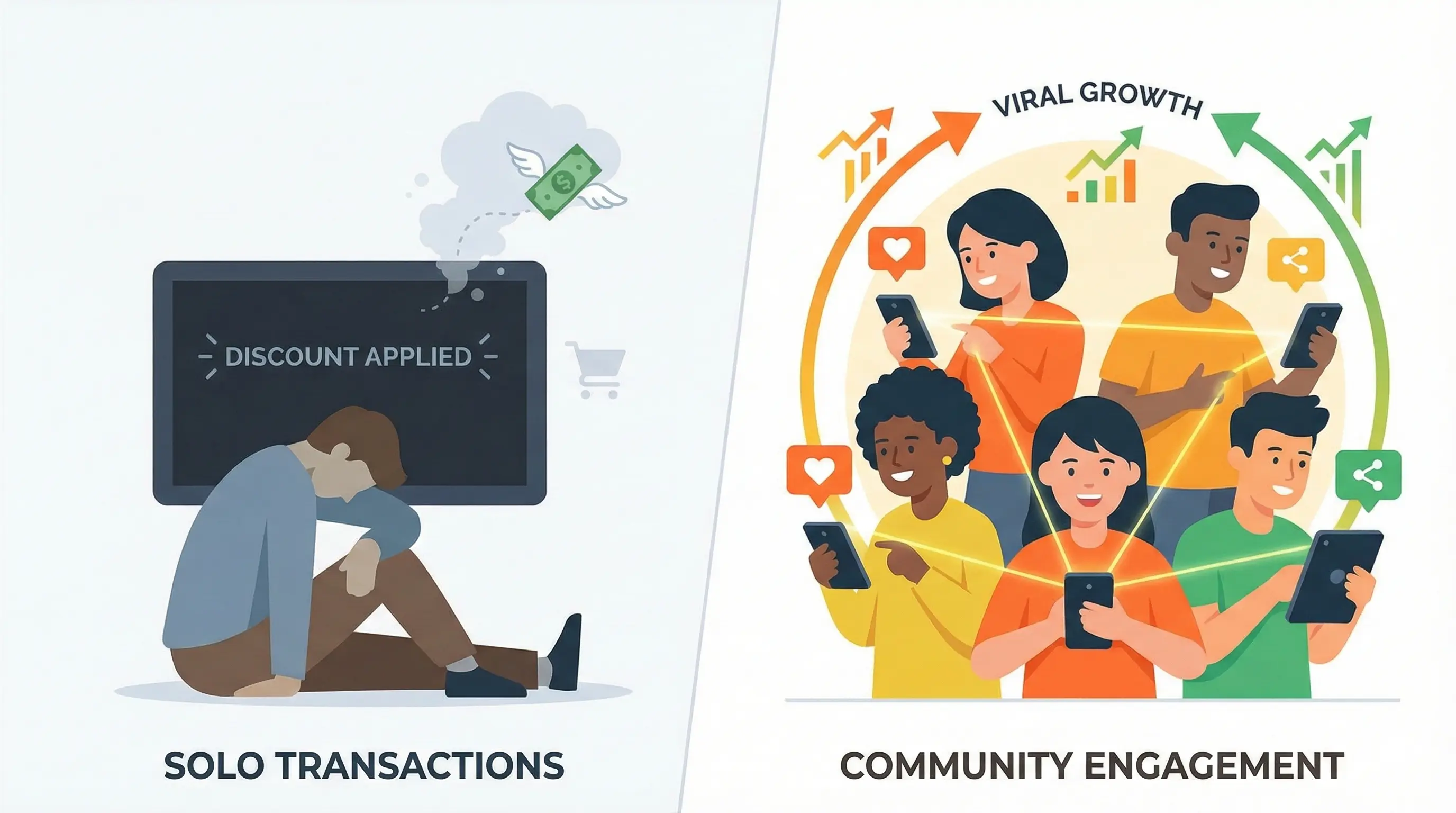
Group Buying wins for viral growth and customer acquisition.
Discount codes are simpler to implement, but group buying turns customers into marketers, reducing CAC by up to 40% while increasing average order value by 25%.
If you've been running a Shopify store for any length of time, you've probably tried discount codes. They're the default strategy: create a code like "SAVE20", blast it to your email list, and hope for a sales bump.
But here's what the industry data tells us: 92% of consumers trust recommendations from friends over any form of advertising (Nielsen Global Trust Study). Yet discount codes don't leverage this trust at all—they just slash your prices and hope for the best.
There's a better way. It's called group buying, and it's the same model that made Pinduoduo worth $130 billion and helped companies like Groupon reshape how consumers think about deals.
In this comparison, we'll break down exactly how these two strategies differ—and why one builds a sustainable growth engine while the other slowly bleeds your margins dry.
At-a-Glance Comparison
| Factor | Discount Codes | Group Buying |
|---|---|---|
| Customer Acquisition | You pay for each customer (ads, email, etc.) | ✅ Customers bring friends for free |
| Viral Potential | Zero—codes are used once and forgotten | ✅ Built-in—sharing is required for savings |
| Margin Impact | Pure cost, no return beyond the sale | ✅ Discounts drive referrals that pay for themselves |
| Customer Behavior | Passive—they use the code and leave | ✅ Active—they become invested promoters |
| Scalability | More customers = more ad spend | ✅ More customers = more free marketing |
| Social Proof | None | ✅ Real-time progress shows popularity |
| Urgency | Often weak ("expires in 30 days") | ✅ Strong (group must fill before deadline) |
| Implementation | ✅ Built into Shopify | Requires app (5-minute setup) |
The Problem with Traditional Discount Codes
Let's be honest about what happens when you run a typical discount campaign:
1. Codes leak and get abused
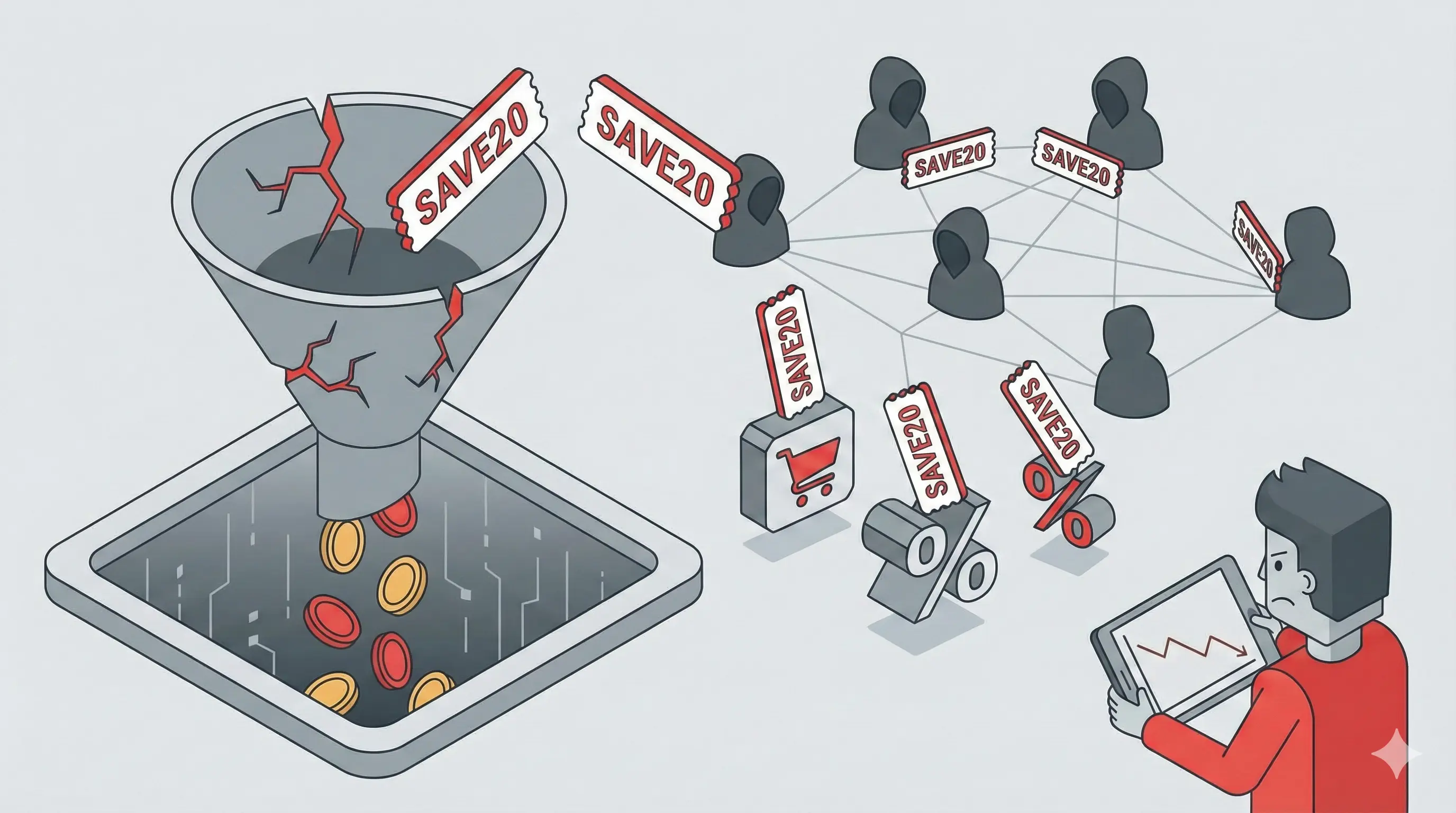
You create "FRIENDS20" for your loyal customers, but within hours it's posted on Honey, RetailMeNot, and every coupon site on the internet. Suddenly everyone—including customers who would have paid full price—is using your exclusive code.
2. Codes train customers to wait
When you run frequent discounts, customers learn the pattern. Why buy now at full price when there's probably a 20% off code coming next month? You've essentially trained your best customers to never pay full price again.
3. Codes don't bring new customers
A discount code doesn't introduce your brand to anyone new. You're just reducing margins on people who already know you exist. The customer acquisition cost? Still whatever you paid to get them there in the first place.
4. Codes are a one-and-done transaction
Customer uses code. Customer buys product. Customer leaves. That's the entire relationship. There's no built-in mechanism for that customer to bring you more customers.
5. Codes provide no social proof
"Here's 20% off" tells the customer nothing about whether other people like your products. There's no FOMO, no bandwagon effect, no sense that they're joining something others are excited about.
How Group Buying Changes the Game
Group buying flips the entire model. Instead of you paying to acquire customers, your customers do the work of bringing their friends—and they're motivated to do it.
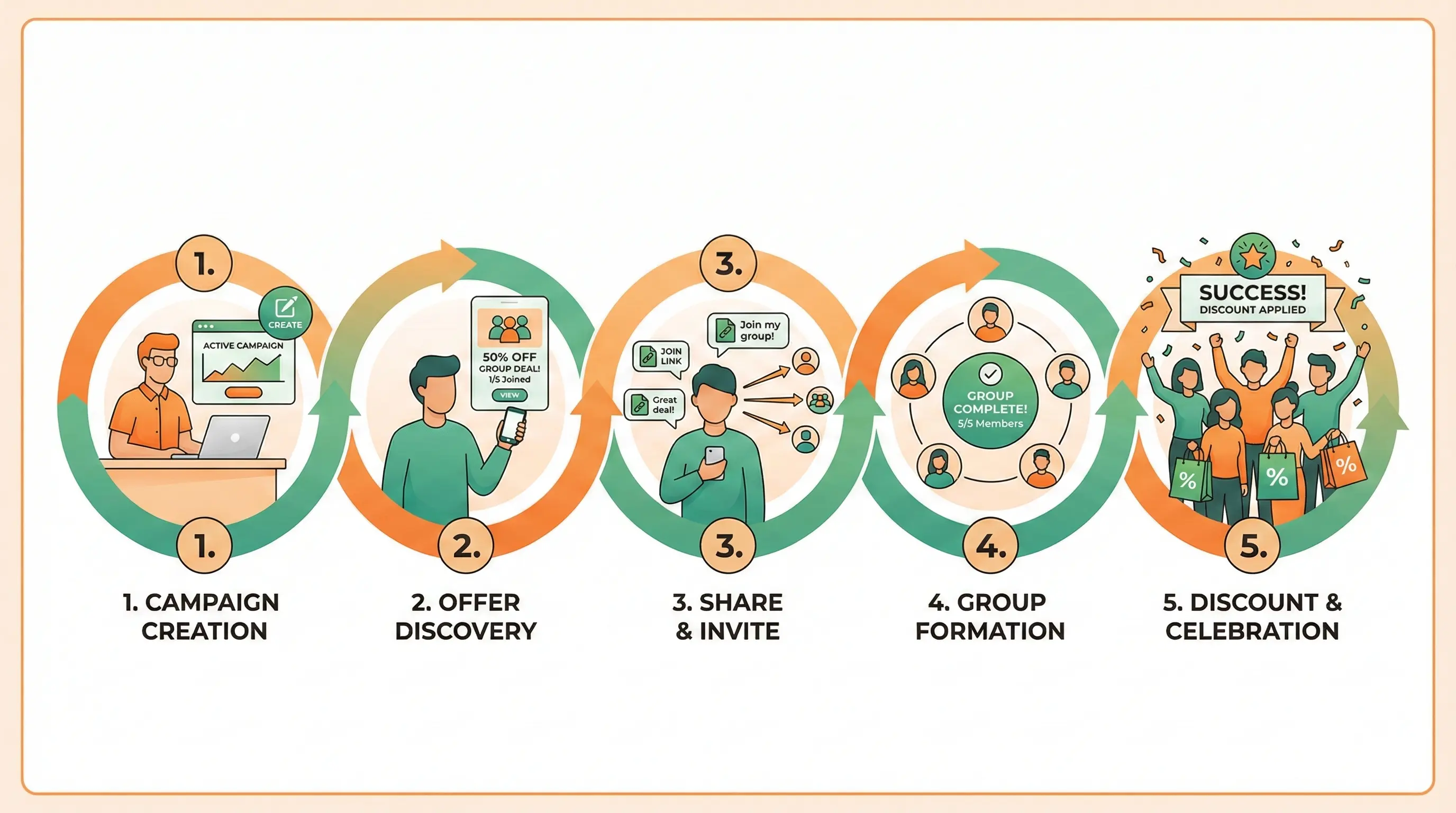
Here's how it works:
You create a group buying campaign
Choose a product, set a target group size (say, 10 people), and define the discount (20% off when the group fills).
A customer discovers your campaign
They see: "Get 20% off these headphones when 10 people join the group. 4 spots remaining, 2 days left."
The customer has a choice
They can wait and hope the group fills, or they can actively recruit friends to make sure everyone gets the deal. Most choose to share.
Sharing happens naturally
The customer sends a link to friends, posts in their group chat, shares on social media. Each share introduces your brand to new potential customers at zero cost to you.
The group fills, everyone wins
When the group reaches the target, everyone gets the discount. The customers feel accomplished. You just acquired multiple new customers without paying a cent in ads.
The Math Behind Group Buying
Let's run the numbers on a real scenario: $100 Product, 20% Discount
❌ Traditional Discount Code Approach
| Price after discount | $80 |
| Customer acquisition cost (ads) | $35 |
| Net revenue per customer | $45 |
| New customers from referrals | 0 |
| Total cost to acquire 10 customers | $350 |
And here's what makes it even better: those 9 referred customers came from trusted recommendations. Research shows that referred customers have:
Real-World Examples: Group Buying in Action
Pinduoduo: From Zero to $130 Billion
China's Pinduoduo used group buying to become the country's second-largest e-commerce platform in just five years. Their model is simple: products are cheaper when you buy as a group, so customers share with friends, family, and WeChat contacts.
Result: Pinduoduo spends a fraction of what competitors spend on customer acquisition while growing faster than anyone else in the market.
Groupon: Pioneering Local Commerce
Before its pivot, Groupon built a $16 billion company on group buying. Local businesses offered deals that only activated when enough people signed up. This created urgency, social sharing, and customer discovery all in one mechanism.
Temu: The New Challenger
Temu's explosive growth in Western markets has been fueled largely by group buying mechanics. Their "shop like a billionaire" approach combines deep discounts with social sharing—and they've acquired millions of customers with minimal traditional advertising.
When Discount Codes Still Make Sense
To be fair, traditional discount codes aren't useless. They still work well for:
The key difference: these use cases treat discounts as tactical tools, not growth strategies. The discount code is a scalpel, not a growth engine.
Making the Switch: How to Implement Group Buying
If you're sold on the concept, here's how to actually make it work for your Shopify store:
1. Choose the Right Products
Group buying works best with:
- Higher price points ($50+) where the discount feels meaningful
- Products with broad appeal that customers naturally want to share
- Gift-worthy items that friends might want too
- Trending or seasonal products with built-in urgency
2. Set Realistic Group Sizes
Start smaller than you think. A group of 5-10 is much more achievable than 50+. Customers need to believe the group can actually fill, or they won't bother sharing.
3. Make Sharing Frictionless
Your customers need one-tap sharing to SMS, email, WhatsApp, and social platforms. Pre-written messages help—most people don't want to craft the perfect pitch for your product.
4. Create Real Urgency
Set campaign deadlines (3-7 days works well). Show real-time progress: "4 of 10 spots filled. 2 days remaining." This creates FOMO and motivates action.
5. Reward the Organizers
Consider extra incentives for customers who create groups and successfully recruit friends. This transforms your most engaged customers into unofficial sales reps.
Introducing Farabiulder: Group Buying for Shopify
We built Farabiulder specifically to bring group buying to Shopify stores.
No coding required. Works with all Shopify 2.0 themes.
Shows real-time group progress on your product pages.
One-click sharing to SMS, email, WhatsApp, and social platforms.
Customer-specific discount codes that can't be shared or abused.
Customers track their groups right in their Shopify account.
Start on the Free plan: $0/month, every feature, and a 4.2% commission on group buy revenue only. Move to a paid plan when a lower rate saves you money — your launch rates lock in when you subscribe.
The results merchants are seeing:
Free to start. Launch your first campaign in 5 minutes.
The Bottom Line
Traditional discount codes are a necessary evil—a tool that solves short-term problems while creating long-term dependencies on price cuts.
Group buying is a growth strategy. It transforms your discount spend into customer acquisition. It turns customers into marketers. It creates urgency, social proof, and viral sharing all at once.
The question isn't whether to give discounts. The question is: what do you get in return for those discounts?
With traditional codes, you get a single transaction.
With group buying, you get a customer who brings friends, who bring their friends, who bring their friends.
That's the difference between a discount code and a growth engine.
Frequently Asked Questions
Will group buying cannibalize my regular sales?
No. Data shows group buying generates incremental revenue rather than replacing existing sales. Most group buying purchases come from new customers who wouldn't have purchased otherwise, or existing customers buying additional items.
What happens if a group doesn't fill?
Incomplete groups expire at the end of your campaign period. No charges are made until a group completes successfully. Customers can easily join new groups or start fresh ones.
Can customers share their discount codes?
With Farabiulder, each customer gets a unique, customer-specific discount code that only works for them. No code sharing, no gaming the system.
What discount percentage should I offer?
15-25% works best for most products. The discount needs to be meaningful enough to motivate sharing, but not so deep that you lose money on the campaign.
How long should campaigns run?
3-7 days is the sweet spot. Long enough for groups to fill, short enough to create urgency.
Ready to Turn Customers Into Your Marketing Team?
Stop paying for every customer. Start letting your customers bring you more customers.
Get Farabiulder for Shopify →Free to start. Launch your first campaign in 5 minutes.
Calculate Your Potential Savings
See how much you could save on customer acquisition with our free calculator.
Calculate Your CAC Savings →