RedTiger acquired 84 customers across 26 completed group buys in four weeks — generating over $16,000 in group-buy revenue while spending $0 on ads. They ran always-on, public group buying campaigns on Shopify through Farabiulder, and 69% of those buyers joined a group that a complete stranger had started. Here’s exactly how they did it.
Most hardware brands on Shopify hit the same wall: a great product, a real audience, and customer acquisition costs that keep climbing. Paid social gets more expensive every quarter, and discount codes just hand margin to people who would have bought anyway.
RedTiger — a dashcam brand with 500K+ users — tried a different formula for their 6th-anniversary event. Instead of buying more clicks, they let customers do the selling. Over roughly four weeks in mid-2026, they ran always-on group buying across three of their flagship dashcams. The result: 26 completed group buys, 84 buyers, over $16,000 in revenue, and zero dollars spent acquiring most of them — because more than two-thirds of those buyers joined a public group that a stranger had already started.
Who Is RedTiger?
RedTiger is a dashcam brand selling multi-channel car cameras to a large, engaged community of drivers. They run an active promotional calendar — anniversary sales, member perks, email newsletters — and have an existing audience that already trusts the products. That made them an ideal fit for group buying: the demand was already there; it just needed a reason to act together.
The Setup: Three Public Group Buys, Running at Once
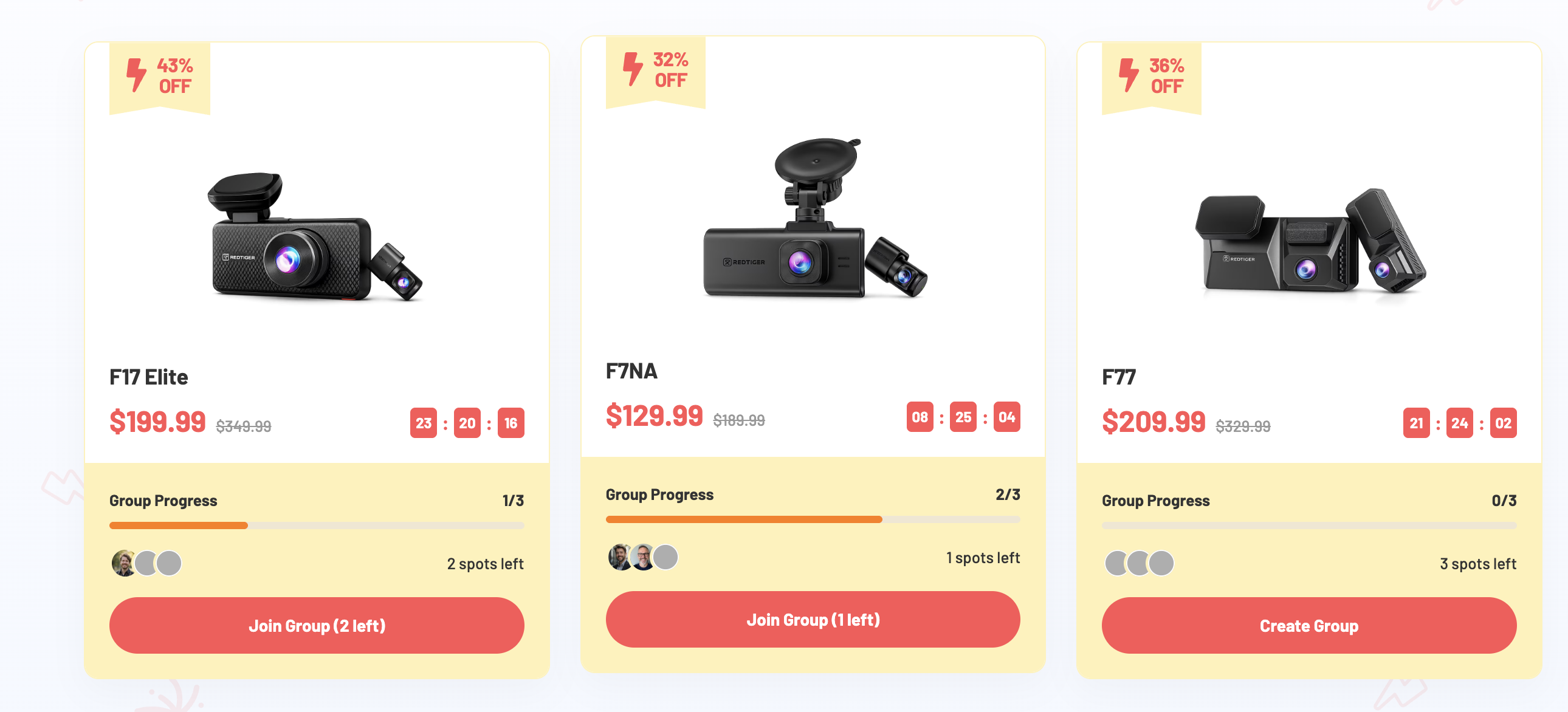
RedTiger ran three simultaneous always-on campaigns — one per hero product — with public, stranger-joinable groups so no one had to recruit friends to unlock the deal.
| Campaign | Product | Group Size | Storefront Discount | Structure |
|---|---|---|---|---|
| F17 Elite Group Buying Specials | F17 Elite | 3 people | up to 43% off | Always-on |
| F7NA Group Buying Specials | F7NA | 3 people | ~32% off | Always-on |
| F77 Group Buying Specials | F77 | 3–5 people | ~36% off | Always-on |
The configuration was deliberately simple: small groups (just 3 buyers needed to complete), public visibility so anyone could join, and discounts deep enough — a third to nearly half off — to make teaming up an obvious win. RedTiger also seeded the program inside an existing moment (the anniversary sale), promoted via their email newsletter with a clear “Join a Group Buy & Save More” call to action.
The Results: One Leader, Two More Buyers
For every shopper who started a group, two more strangers arrived on their own — no recruiting required.
Across the three campaigns, 26 groups reached completion, bringing in 84 paying customers in about four weeks. But the headline isn’t the order count — it’s where those orders came from.
Each group is started by one leader. Of the 84 buyers, only 26 were leaders. The other 58 — 69% of all buyers — were people who found a public group and joined it. They weren’t invited. They weren’t recruited. They saw an open group on the product page, saw the spots filling, and jumped in to lock the discount.
This is what “turn shoppers into marketers” looks like in practice. A leader starts a group to save money, and in doing so creates a public, time-limited offer that pulls in additional buyers — buyers who can then become leaders of their own next group. Compare this to the Benalor Jewelry case study, where the same public-group mechanic drove $8,070 in revenue from 8 buyers and zero ad spend.
Why Stranger-Joinable Groups Were the Engine
The single most important decision RedTiger made was keeping groups public — and it’s the decision that separates group buying from every other referral mechanic.
The biggest reason customers don’t join a group order is the assumption that they have to round up friends first. Public groups remove that objection entirely.
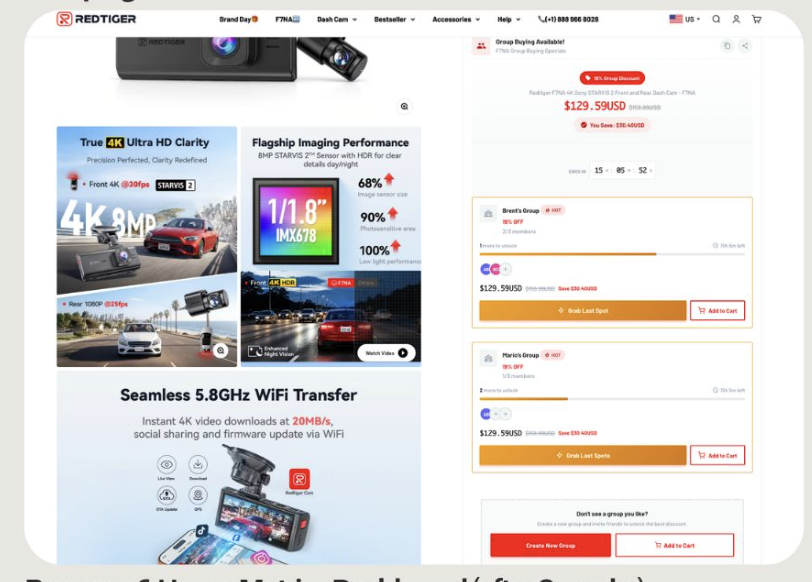
When a shopper lands on the F17 Elite page and sees a group at “2 of 3 spots filled — 1 spot left,” the path is obvious: join, pay, done. No sharing required, no waiting on friends. The group buys that completed fastest were the ones where strangers filled the open seats within hours of a leader creating them. That only works because the groups were joinable by anyone.
The Part That Makes It Risk-Free
Automatic refunds on unfilled groups remove the buyer’s biggest anxiety — and cost the merchant nothing.
Not every group fills — and that’s by design, not a problem. During the program, plenty of groups didn’t reach their minimum before expiring. Every one of those shoppers was automatically refunded, with no manual work from RedTiger’s team.
This is the guarantee that makes buyers comfortable committing in the first place: they know they’ll only be charged if the deal actually happens. For the merchant, an unfilled group costs nothing — no ad spend wasted, no margin given away, no support tickets. The completed groups drove revenue; the incomplete ones quietly refunded themselves. Downside protected, upside uncapped.
The Economics
Group buying flips the paid-ads model: acquisition cost comes out of a completed sale, not before it.
Traditional paid ads — you spend on clicks before any revenue arrives. At typical dashcam-category customer acquisition costs, acquiring 58 net-new customers through Meta would run well into four figures, paid up front, with no guarantee of conversion.
Group buying (RedTiger) — ad spend on those 58 joiners was $0. The only cost was the discount, and the discount comes out of a completed sale, not before it. You don’t spend money to find customers; customers arrive with the spend already in hand. Across the 84 completed seats, RedTiger generated over $16,000 in group-buy revenue — an average order of roughly $196 — with the acquisition cost baked inside each transaction.
Put plainly: while most Shopify stores were paying Meta for every click, RedTiger pulled in $16K+ with their customers doing the selling.
“For every customer who started a group, two more strangers came along for the ride.” — RedTiger Group Buying Results, June 2026
The Group Buying Playbook (Steal This)
RedTiger’s approach is repeatable for any Shopify brand with an existing audience. Here’s the five-part framework:
-
Run it on your hero products. Group buying amplifies demand that already exists. RedTiger chose their three best-known dashcams, not slow movers.
-
Keep groups small and public. A 3-person, stranger-joinable group fills fast and needs no friend recruiting. Small completes; public spreads.
-
Make the discount worth acting on. 30%+ off turned “maybe later” into “join now.” The deal has to be meaningfully better than the solo price.
-
Run it always-on, not as a one-off. RedTiger left campaigns open during the anniversary window so a new group could form the moment the last one completed. Continuous availability compounds.
-
Tie it to a moment and email it. They folded group buying into an existing anniversary promo and pushed it through their newsletter with a direct “Join a Group Buy” CTA. Use the audience you already have.
What This Means for Your Store
Every Shopify store with an existing customer base can run the same mechanic RedTiger ran — today, for free.
The stores moving first compound the advantage. Group buying builds on itself: each completed group creates social proof on the product page, which pulls the next strangers in. A store that starts now is weeks ahead of one that waits. RedTiger didn’t have a special audience or a bigger budget — they had a public group mechanic running on products people already wanted.
If your customer acquisition costs keep climbing and your discount codes keep getting abused, the setup RedTiger used is a 5-minute install with a free plan. The first group buy could run this week.
⚡ Run group buying on your Shopify store — the way RedTiger turned 26 group leaders into 84 buyers and $16K+ with $0 ad spend. Farabiulder is the only native group buying app on Shopify. Public, stranger-joinable groups turn your shoppers into marketers. Intro launch pricing. 5-minute setup. Works with all Shopify 2.0 themes. Start on Shopify →
Frequently Asked Questions
How much revenue did RedTiger make from group buying?
RedTiger generated over $16,000 in group-buy revenue in about four weeks across 84 buyers — an average order around $196 — with $0 spent on ads. Most of those buyers came in as strangers joining public groups, so acquisition cost on them was effectively zero.
How did RedTiger acquire customers with $0 ad spend?
RedTiger ran public group-buy campaigns on their existing Shopify product pages and promoted them through their email newsletter. Because groups were stranger-joinable, each group a customer started pulled in additional buyers automatically — no paid acquisition required for those 58 stranger joiners. The result: over $16,000 in revenue at $0 ad spend.
Do customers need to find friends to join a group?
No. RedTiger kept groups public, so any shopper could join an open group started by someone they'd never met. This removed the biggest adoption barrier — 'do I need friends first?' — and drove 69% of all buyers to come in as strangers joining existing groups.
What happens to groups that don't fill?
Every participant in an unfilled group is automatically refunded. There is no risk for the buyer and no cost or manual work for the merchant. Unfilled groups simply expire and refund themselves — downside is fully protected, upside uncapped.
Can group buying work for higher-priced electronics?
Yes. RedTiger's dashcams were priced from roughly $130 to $210 after discount. A 30–43% saving is a real incentive at that price point. Group buying works for any product with existing demand where the discount meaningfully motivates action.